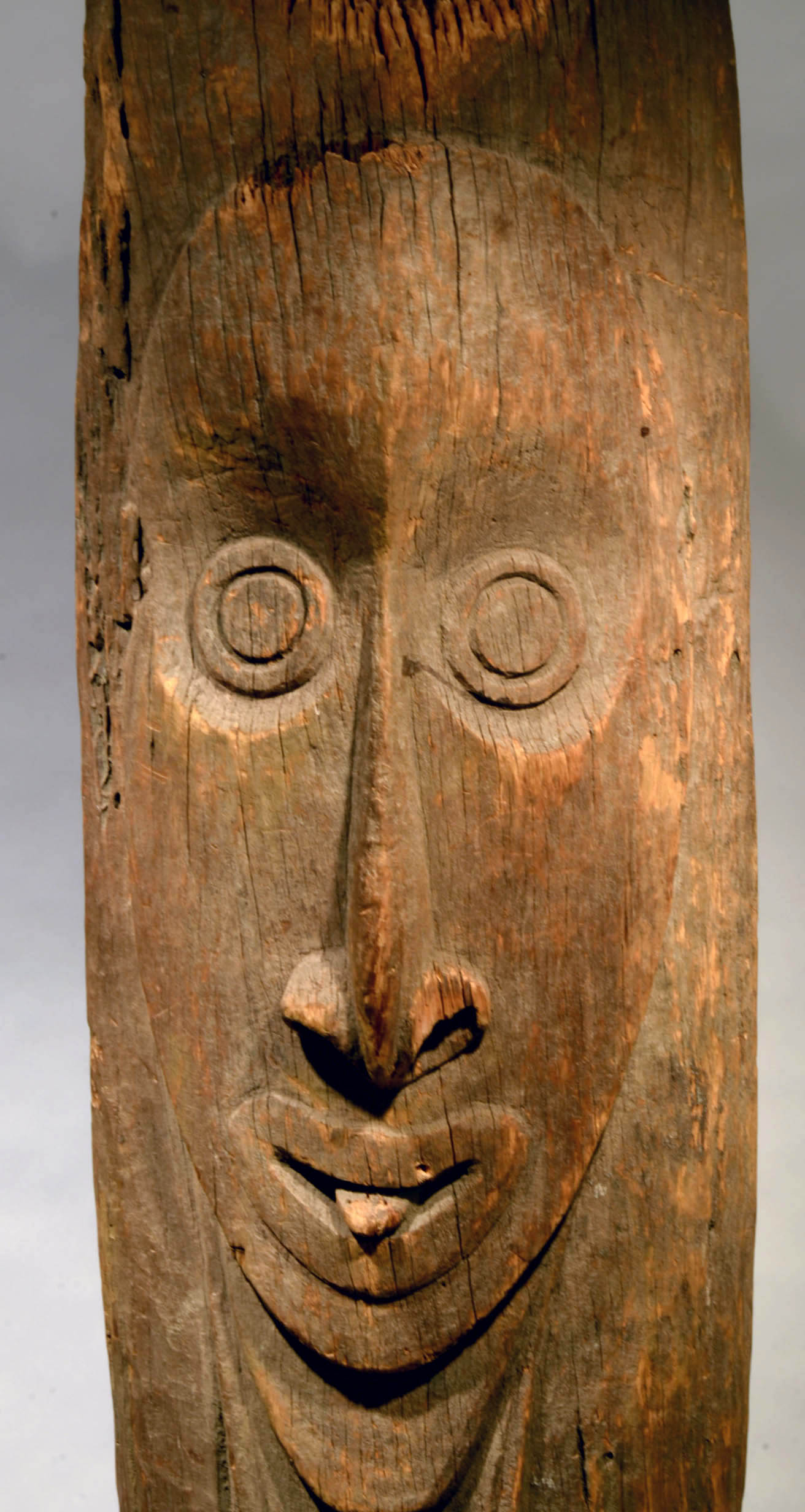
Tanzania, late 19th to early 20th century AD
Large standing figure (mabinda) with articulated arms, carved from a single tree trunk and covered with a dense, crusted dark patina. The attenuated, columnar body, narrow sloping shoulders, and small feet form a compact vertical mass, from which the long arms are pegged at the shoulders; the right arm is bent dramatically so that the hand touches the neck, while the left hangs close to the flank. The slightly oversized head is capped with a low domed coiffure rendered as a thick carpet of individually inserted wooden pegs, enhancing the figure’s animated presence and recalling the heightened theatricality valued in Sukuma dance sculpture. Extensive sacrificial accretions, burning, and age cracks testify to prolonged ritual use.
Scholarly and field accounts describe such large, roughly modeled figures as mabinda (also ibinda), created by Sukuma carvers for use in competitive dry‑season dance societies. Articulated arms allowed the performer to manipulate the figure in front of the crowd, transforming it into a powerful “actor” that intensified spectacle, attracted audiences, and advertised the potency of the sponsoring healer or troupe. The present example’s near life‑size scale (147 cm), articulated limbs, rough-hewn yet imposing body, and thick sacrificial surface place it securely within this corpus and argue for a Sukuma attribution. Closely related Nyamwezi statuary tends to favor inset beaded eyes and more polished surfaces, features absent here, further supporting the identification of this work as a Sukuma mabinda figure rather than a Nyamwezi ancestor image
Size: 58 h x 16 w x 17 d in (147 x 41 x 43 cm) + base.
Yale archive # 0086371 and although here it's labeled Makonde, this attribution can be excluded as the figure lacks the finely carved ebony, compact scale, scarification motifs, and shetani or ujamaa iconographies that characterize Makonde sculpture, and instead conforms to the rough-hewn, large-scale Sukuma/Nyamwezi mabinda type.
Provenance: Private Collection, California originally acquired from an anonymous seller in 1981, and it was auctioned by Loudmer-Poulain in Paris on June 24, 1981, in the "Arts Primitifs" sale, Lot 144, with an estimated price of 25,000-30,000 French Francs and a final price of 30,000 French Francs (roughly 6,800 US dollars, using an average 1981 exchange rate of about 4.4 FRF per 1 USD).