


The Lure to Collecting Greek and Roman art of the Past
 Collecting Greek and Roman art, for us, is about finding pieces where the history and the artistry are equally strong, and where you can feel an individual personality behind the work. A perfect example is the Roman marble statue of a youthful Bacchus. Even in its fragmentary state, you can see the languid elegance of the god of wine and ecstasy: the tilt of the torso, the soft modeling of the flesh, the suggestion of drapery and vine wreaths that once made his identity unmistakable. This is not an anonymous “classical figure,” but a very specific god, conceived to embody pleasure, abundance, and a slightly dangerous charm. Placed on a simple stand in a modern room, he still carries that atmosphere—Bacchus as the eternal guest at the table, presiding over good wine and good company.
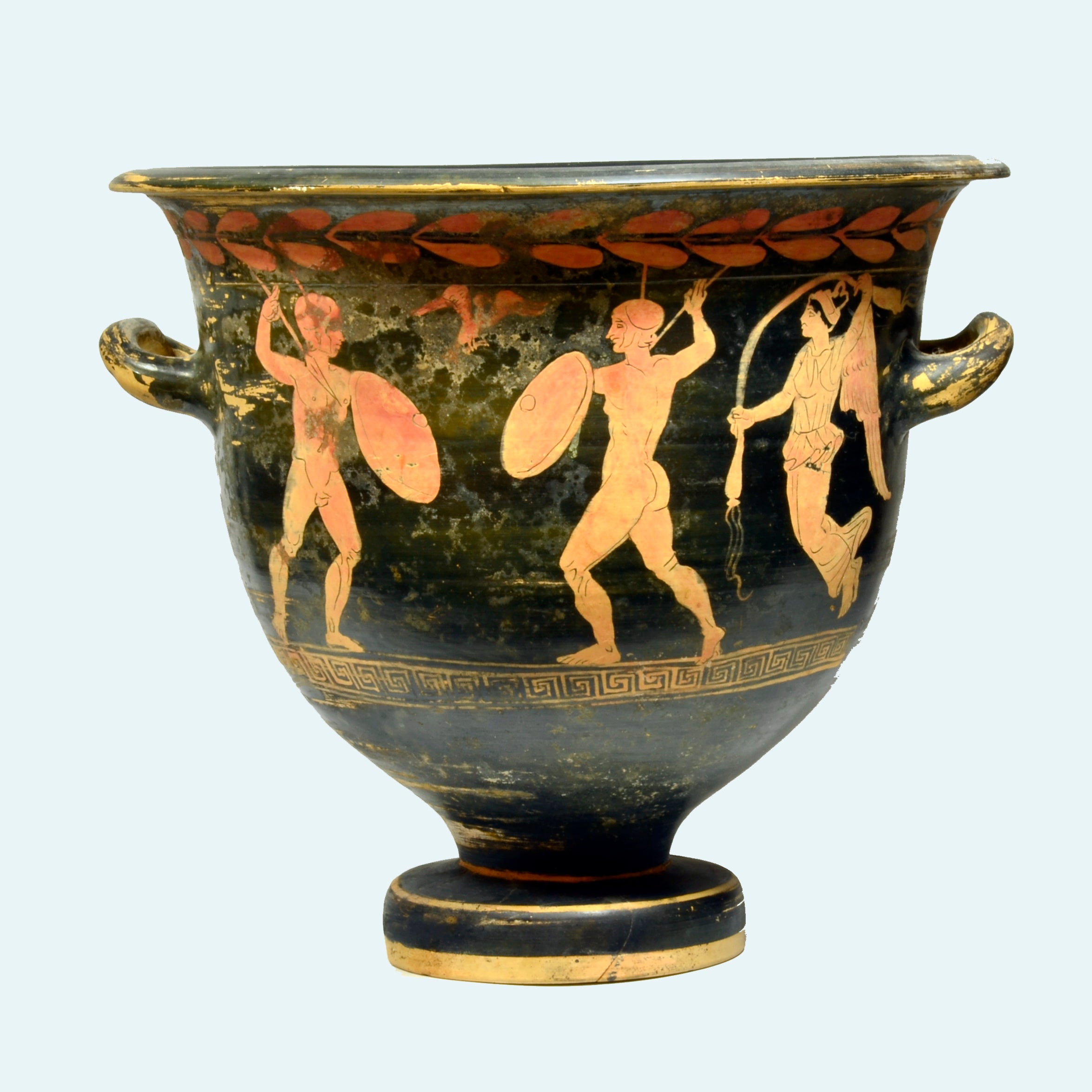
 The Etruscan red‑figure bell krater with hoplites offers a very different window into the ancient world. Painted in rich red and black, it shows armed warriors striding and confronting one another, a mock Olympic or quasi‑athletic scene in which the trappings of warfare and sport intersect. It is both serious and slightly playful: the armor and helmets are rendered with care, but there’s a knowing wit in the poses and gestures, as if the painter is commenting on the spectacle of competition as much as depicting it. This is the sort of vase that rewards close study—you start with the overall scene, and then find yourself drawn into the details of shield devices, musculature, and the rhythm of the composition around the curve of the vessel. On a shelf or in a niche, it brings an entire world of ancient athletics, rivalry, and theater into your home.
 Jewelry adds a level of intimacy that sculpture and vases, for all their power, cannot quite match. The Greek gold lion‑headed termini twisted‑wire earrings are a superb example. The terminals in the form of lion heads are not just decorative; they speak to ideas of strength, protection, and royal power that would have been immediately understood in the ancient world. The twisted gold wire is both technically sophisticated and wonderfully tactile, catching the light in fine, shifting highlights. These are earrings that once framed someone’s face two thousand years ago, announcing status and taste. To wear them today, or even to keep them in a small display, is to participate in a very long tradition of adornment and symbolism, where a tiny lion’s head still carries the same charge it did in antiquity.
 The Roman gold cameo inscribed ring works on yet another level of intimacy. Here you have a finely carved cameo—an image raised from layered stone—set into a gold bezel, and then further personalized by an inscription. The combination of portrait or emblem and text turns the ring into a kind of micro‑monument, a declaration of identity, loyalty, or affection that was meant to be seen every day by its owner and those close to them. When you hold such a ring, you are looking at words and imagery chosen deliberately by someone who lived under the Roman Empire, perhaps used as a seal on wax or simply cherished as a precious personal object. There is something remarkably direct about that connection: the same inscription you read now is the one they commissioned and handled with their own hands.
When you bring together a Roman marble Bacchus, an Etruscan bell krater with hoplites, Greek gold lion‑headed earrings, and a Roman inscribed cameo ring, you are not just assembling attractive objects; you are curating a constellation of stories. The Bacchus speaks of myth, ritual, and the pleasures of the symposium. The krater evokes athletic competition, public display, and the Etruscan eye on Greek culture. The earrings capture the ancient language of luxury and protection in miniature. The ring, with its cameo and inscription, preserves a very personal voice from the Roman world. Together they form a rich, multidimensional portrait of the ancient Mediterranean, in which gods, athletes, artisans, and private individuals all have their place.
I see the role of the collector of such pieces as that of steward and guardian. These works have already survived two millennia of war, neglect, burial, and rediscovery; our task is to shepherd them safely through our own brief moment in that long timeline. To acquire a piece like the youthful Bacchus, the Etruscan krater, or the ancient gold jewelry is to accept a responsibility as well as a pleasure: to care for the object properly, to preserve its documentation and provenance, and to ensure that its story is not lost. For many of my clients, the natural culmination of this stewardship is to think ahead to legacy—whether that means eventually placing key works in a museum collection, or at least creating the conditions under which heirs can do so with clarity.
If you feel drawn to the idea of becoming the next guardian of pieces like these, I invite you to look closely at the Roman marble Bacchus, the Etruscan bell krater with hoplites, the Greek lion‑headed earrings, and the Roman gold cameo ring, and to imagine where they might live in your own space and in your own story. From there, we can discuss not only acquisition, but also long‑term care, documentation, and future placement, so that what you collect now can one day move gracefully from private stewardship into the public trust of a museum, continuing its journey through history long after us.
Buying from Art For Eternity Gallery is a very personal experience, because this is not a large, anonymous operation but the life’s work of Howard Nowes. Over decades, Howard has built the gallery object by object, with a focus on authenticity, strong provenance, and pieces that have real character, not just a date and a label. When you visit the gallery or correspond about a particular work, you are dealing directly with the person who selected it, researched it, and cares what happens to it next. Questions about history, condition, comparanda, and long‑term value are welcomed, not brushed aside, and the goal is always to match the right piece with the right collector rather than to make a quick sale. For many clients, that combination of scholarship, connoisseurship, and one‑on‑one attention makes acquiring an antiquity here feel less like a transaction and more like joining an ongoing conversation—one that links you, the object, and its future journey to a museum or next generation of stewards.