




The Olympian's Kit: An Ancient Bronze Strigil and Aryballos for the Modern Athlete
 Picture the valley of the Alpheios in high summer. The air above the sanctuary of Zeus at Olympia shimmers with heat, the stadium track is packed earth, and the young men who have walked from every corner of the Greek world are about to strip, oil their bodies, and race for nothing more than a crown of wild olive leaves. Before a single footrace, wrestling bout, or boxing match began, each of them reached for the same two objects: a small flask of olive oil and a curved bronze scraper. Twenty-four centuries later, that pairing survives here, intact and ready to be handed to a new athlete.
The Olympian's Daily Ritual
Greek athletes trained and competed nude, and their preparation was as ritualized as the games themselves. On arrival at the gymnasium or palaestra an athlete undressed and covered his body with olive oil, then dusted himself with fine sand; according to the International Olympic Committee's guide to the Games in antiquity, the oil and sand helped regulate body temperature and protected the skin from the sun and even from the trainer's stick. The University of Leuven's Ancient Olympics project notes that the Greeks themselves debated why they did it, whether to supple the muscles, to guard against sun and cold, or simply for the beauty of the gleaming body, and that the scent of the oil was considered distinctly masculine.
After the exertion came the scraping. Oil, dust, and sweat left the athlete coated in a sticky film, and he drew a bronze blade called a xystron in Greek, strigilis in Latin, down his limbs to clean them, a motion that also served as a massage. He then washed with water and a sponge and often anointed himself again, sometimes with perfumed oil, to keep the skin from drying. The flask that held that oil was the aryballos, and the IOC guide describes how aryballos, strigil, and sponge were linked together on a ring that the athlete hung on the wall of the gymnasium, his personal kit waiting for him each day.
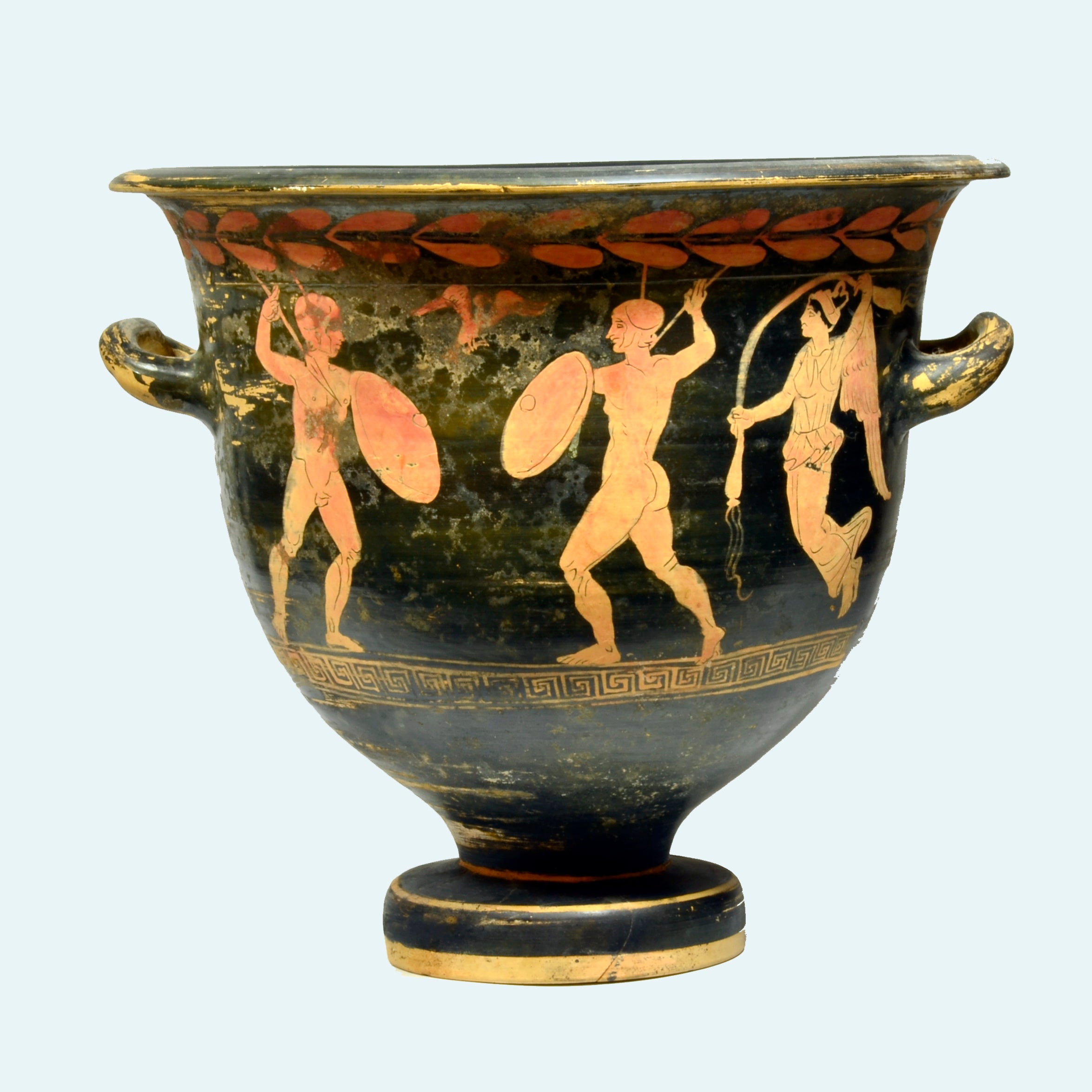
The gesture became one of the defining images of Greek art. The sculptor Lysippos made it famous in the fourth century BC with his Apoxyomenos, "the Scraper," a victorious athlete caught in the act of cleaning his outstretched arm; the Vatican Museums' Roman marble copy still shows him removing sand and oil with his strigil. Vase painters returned to the scene again and again, and you can see a nude victor with his strigils on our own Apulian red-figure chous (which was sold).
For a Crown of Olive Leaves
The Olympic Games were held in honor of Zeus, first recorded in 776 BC, and were the most prestigious of the four Panhellenic contests. Olympia was never a town but a sanctuary, its sacred Altis crowded with temples, altars, and the treasuries of rival city-states. The prize was famously modest: a wreath of wild olive, a red woolen ribbon, and a palm frond, followed by a banquet. Yet as the IOC recounts, a champion returned home to a hero's welcome, a lifetime of honors, the right to a statue, and verses composed by poets in his name. Lesser games paid in amphorae of olive oil, bronze tripods, and silver cups, but nothing outranked the leaves of Olympia. Every one of those victors began his day with the oil flask and the strigil. For more on the contests themselves, see our earlier post on the Ancient Olympic Games.

The Set
The strigil is cast and hammered bronze, a long, gracefully curved blade (the ligula) formed as a deep, U-sectioned channel that gathered oil and grime as it was drawn across the skin, its rounded tip turned slightly upward. The handle (the capulus) is a flat bronze strap that rises from the blade and folds back upon itself into an elongated open loop, through which the athlete slipped his fingers or the ring of his kit, its free end tapering to a pointed, leaf-shaped terminal that once seated against the back of the blade. The surface carries an even, smooth olive-green patina with scattered earthen deposits. It measures 9-7/8 inches (25.1 cm) in length and stands 8-1/2 inches (21.6 cm) high on its custom metal cradle and dark wood base. Strigils of this form are well represented in museum collections, cf. the Greek Classical bronze strigil, 5th–4th century BC, at the Metropolitan Museum of Art (14.105.2), which the Met notes was used to scrape the skin clean after oiling, a procedure vase paintings show athletes following after exercise. Provenance is the Hanita & Aron Dechter Collection. Published The Dechter Collection of Greek Vases, University Art Gallery, California State University, San Bernardino; Exhibition, May 5 - June 2 1989, checklist no 83.
Its companion is a Graeco-Roman bronze aryballos of about the 4th to 1st century BC, a perfectly portable oil flask with a globular body encircled at the belly by paired incised bands, set on a low ring foot. A short, narrow neck controlled the flow of precious oil and rises to a broad, shallow dish-shaped mouth, and a separately cast strap handle springs from the shoulder to the rim, ending in a rounded knob that served as a thumb rest for a secure grip with oily hands. Bronze examples were far costlier than the common terracotta flasks and point to an owner of means. The vessel is covered in a rich green crystalline patina with russet and earthen highlights, the handle reattached. It stands 3-1/4 inches (8.3 cm) high, and 4-1/4 inches (10.8 cm) on its base. The Museum of Art and Archaeology at the University of Missouri exhibits just such a pairing, a bronze strigil with a bronze oil flask, explaining that Greeks, Etruscans, and Romans drizzled olive oil from the flask before scraping away oil, sweat, and dirt, olive oil serving them as we use soap. The aryballos comes from the Estate of Rosa and Aaron Esman, Lexington Avenue, New York, the noted gallerist and print publisher and her psychiatrist husband, who shared a lifelong devotion to the arts.
A Gift Worthy of a Champion
Trophies are manufactured by the thousand every season. This is something different: the actual equipment of the ancient athlete, the tools that carried the oil of the gymnasium and scraped away the dust of the stadium more than two thousand years ago. For the marathoner, the wrestler, the collegiate rower, the coach who has given a career to the sport, or the professional who has everything except a piece of the Games' own origin story, the strigil and aryballos speak a language every athlete understands: preparation, discipline, effort, and recovery. Displayed together on their bases in an office, a trophy room, or a home gym, they connect a modern achievement to the first Olympians who competed for glory alone.
Both objects are offered individually or together as a set from Art For Eternity Gallery. To reserve the set, request additional photographs, or arrange a gift presentation, please contact the gallery. You may also enjoy our Roman iridescent glass aryballos, a later bathhouse cousin of the bronze flask.
