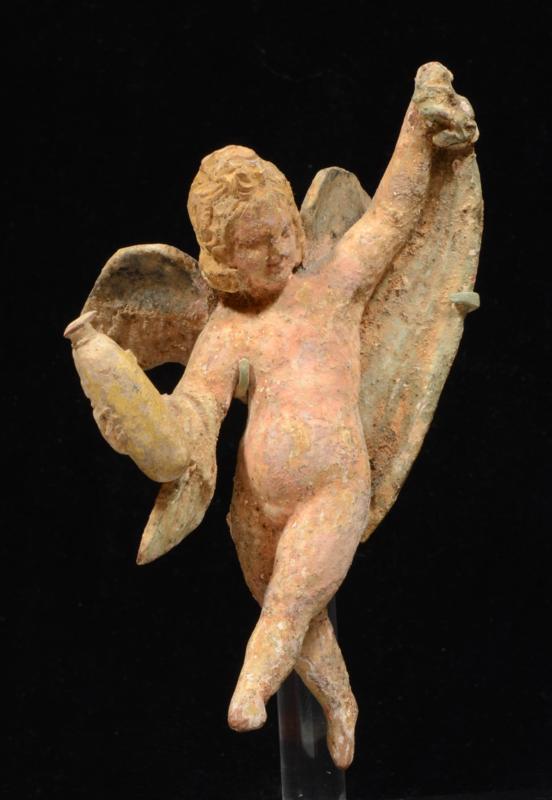
Bura Terracotta Anthropomorphic Urn

Bura Terracotta Anthropomorphic Urn

17710

Regular price$2,850
/
Shipping calculated at checkout.

  • Free insured US shipping on most pieces
  • Guaranteed authentic, with signed certificate of authenticity
  • 14-day returns

This site is protected by hCaptcha and the hCaptcha Privacy Policy and Terms of Service apply.

Pre-colonial African Bura (Bura-Asinda-Sikka) terracotta anthropomorphic funerary urn, Niger River region, Niger/Burkina Faso, ca. 3rd–11th century CE.

Modeled in buff-orange clay, the tall bullet- or shell-shaped vessel rises to an abstract human head, with an applied ridged headband, a stylized face bearing small button eyes and nose, and rope-like beaded collars and pendant ornaments rendered in raised roulette-impressed cordons across the "chest" of the vessel. The rounded body is otherwise plain and coarsely surfaced, with an open mouth at the top and an old break at the lower edge, mounted for display on a custom metal stand.

Vessels of this type functioned as funerary urns in the Bura-Asinda burial grounds, set vertically into the earth as grave markers and containers associated with secondary burial and ancestral commemoration, often capping interments or holding remains and offerings. The urn measures 17 inches (43.2 cm) in height on its stand. Condition: heavy earthen encrustation, surface abrasion, and losses to the lower rim consistent with excavation and great age.

Cf. The Metropolitan Museum of Art, New York, holds related Bura anthropomorphic terracotta funerary vessels of the Niger inland delta tradition.

Provenance: Designer Mary McFadden (1938–2024) "The Archaeologist of Seventh Avenue". Mary was one of the most distinctive and intellectually adventurous American fashion designers of the late twentieth century, celebrated for collections that drew directly on the art and dress of ancient and non-Western civilizations. Her signature finely pleated "Marii" silk gowns evoked the chitons of classical Greece and the pleated linens of pharaonic Egypt, while her use of color, ornament, and motif borrowed openly from Africa, Asia, pre-Columbian America, and the ancient Mediterranean. This deep engagement with the material culture of the past earned her the memorable nickname "the Archaeologist of Seventh Avenue."

A former editor at Vogue and a tireless world traveler, McFadden was as much a collector and connoisseur as a couturier. She assembled an eclectic personal collection of antiquities and ethnographic art gathered over decades of travel, which she frequently cited as the inspiration for her designs. Her work was widely exhibited and collected, and she was inducted into the Coty American Fashion Critics' Hall of Fame, cementing her reputation as a designer whose creativity was rooted in the study of the ancient world.

Every object is guaranteed authentic and as described, and has been legally acquired and imported in accordance with U.S. and applicable foreign regulations on the movement and sale of antiquities. A signed certificate of authenticity with a description and photograph accompanies this object. Any restoration is described on the invoice.

Free insured shipping within the United States on most pieces; oversized works are quoted at checkout. We pack and ship ourselves, usually within two business days. International shipping by USPS or DHL is calculated at checkout; if your country is not listed, write to us. Customs forms state the full value; international buyers are responsible for duties and taxes.

Any object may be returned within 14 days of receipt for a refund or credit. Contact us first. See Buying from Us.


You may also like


Recently viewed