Greek or Thracian, ca. 6th–5th century BC
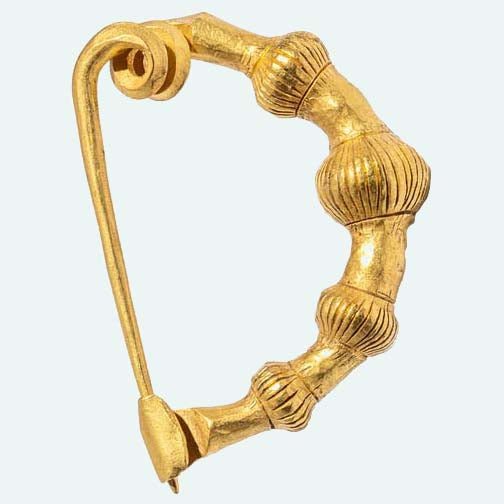
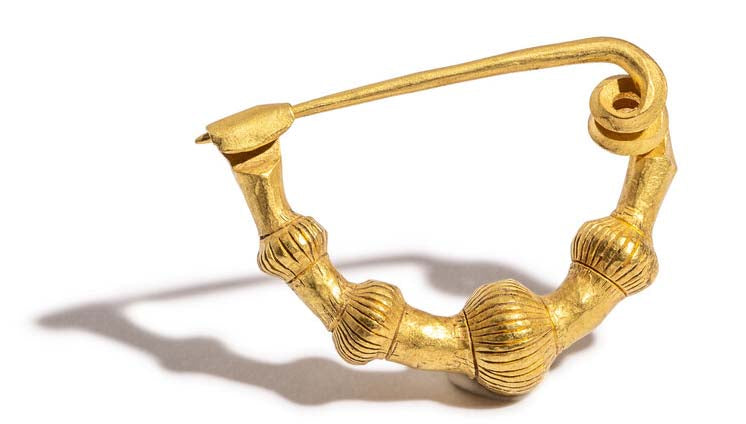
A substantial ancient solid gold fibula formed as a thick curved bow articulated with decorative ribbed and notched lobes, terminating in an ingeniously integrated coiled spring pin and catch plate. The form belongs to the bow/leech (sanguisuga) fibula tradition of the Archaic and early Classical Greek and Thracian world, where such brooches fastened garments and served as displays of wealth and status. Executed in high-karat unrefined gold of warm color, the piece is solid, well-preserved, and retains its functional spring mechanism.
A non-destructive XRF elemental analysis (Manhattan Gold & Silver, Inc.) records a composition of 86.1% gold, 12.0% silver, 1.37% copper, and 0.53% iron (20.6K) — a profile fully consistent with naturally occurring, unrefined ancient gold, in which silver occurs as a substantial natural impurity and minor copper and iron reflect primitive processing.
Length: 1-5/8 in. (2.86 cm); Weight: 27.42 g (17.6 dwt)
Condition: Intact, excellent condition; spring and catch functional
Cf. Comstock & Vermeule, Greek, Etruscan and Roman Bronzes in the Museum of Fine Arts, Boston (MFA, 1971), for related fibula forms. Cf. R. Hattatt, Ancient and Romano-British Brooches, for comparable bow-brooch construction in bronze. Cf. The Metropolitan Museum of Art, gold sanguisuga-type fibulae, 6th–5th century BCE.
Provenance
Private Cleveland, Ohio collection; purchased from Fortuna Fine Arts, New York, acquired 26 May 2005.
XRF elemental analysis report (Manhattan Gold & Silver, Inc.), 12/23/2024
86.1% gold (Au)
12.0% silver (Ag)
1.37% copper (Cu)
0.53% iron (Fe)
This composition aligns with ancient metallurgy practices for several reasons:
The high gold content with substantial silver is consistent with naturally occurring gold that was not refined, which was common in ancient times.
The presence of copper and iron in small amounts is typical of ancient gold artifacts that weren't highly refined. Ancient gold typically contained silver as a natural impurity, often in substantial amounts. The ability to refine gold to increase purity wasn't mastered until around 500 BC. The presence of small amounts of iron and copper is also consistent with primitive processing methods.