Egypt, probably the Fayum, Roman Period, ca. 1st–2nd Century AD
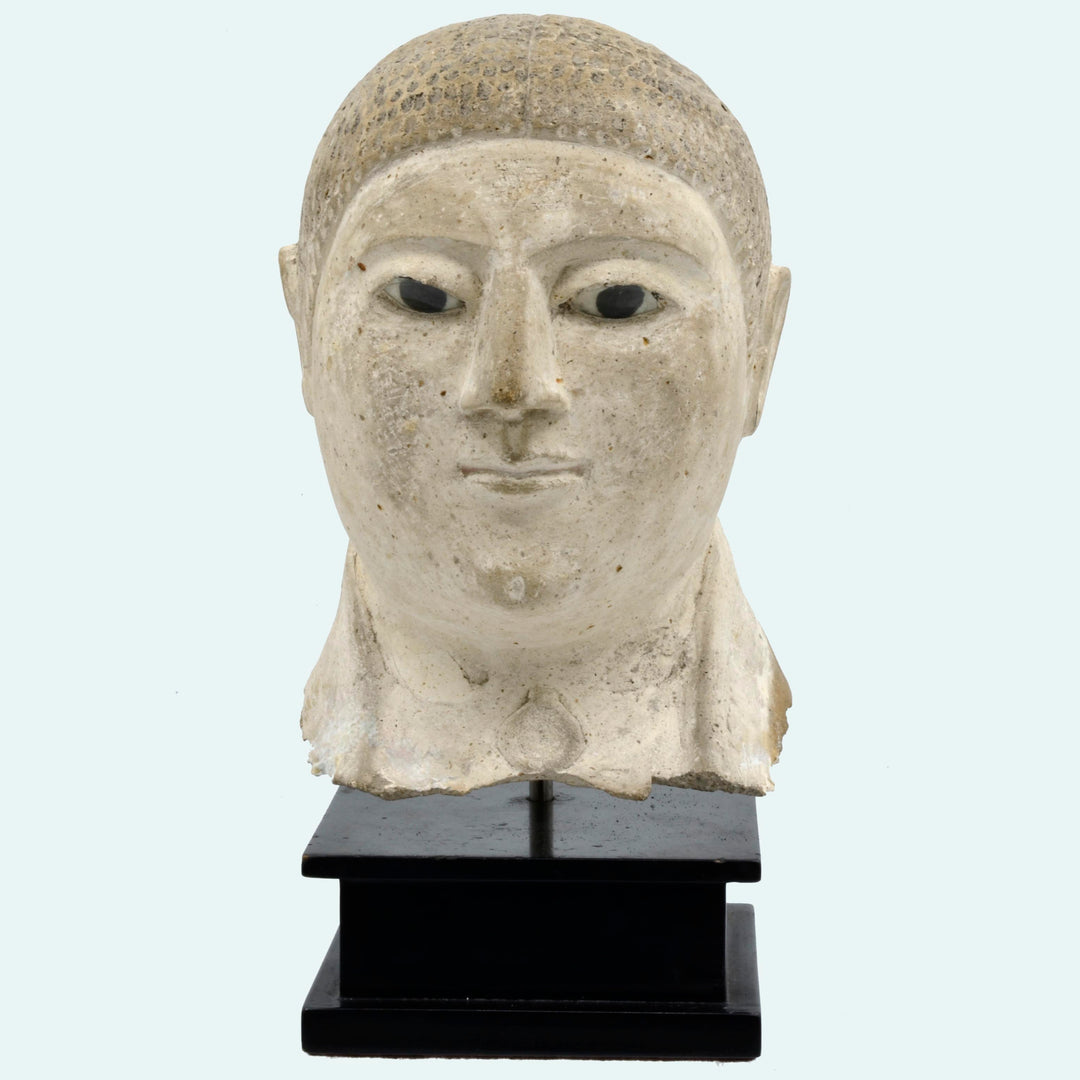
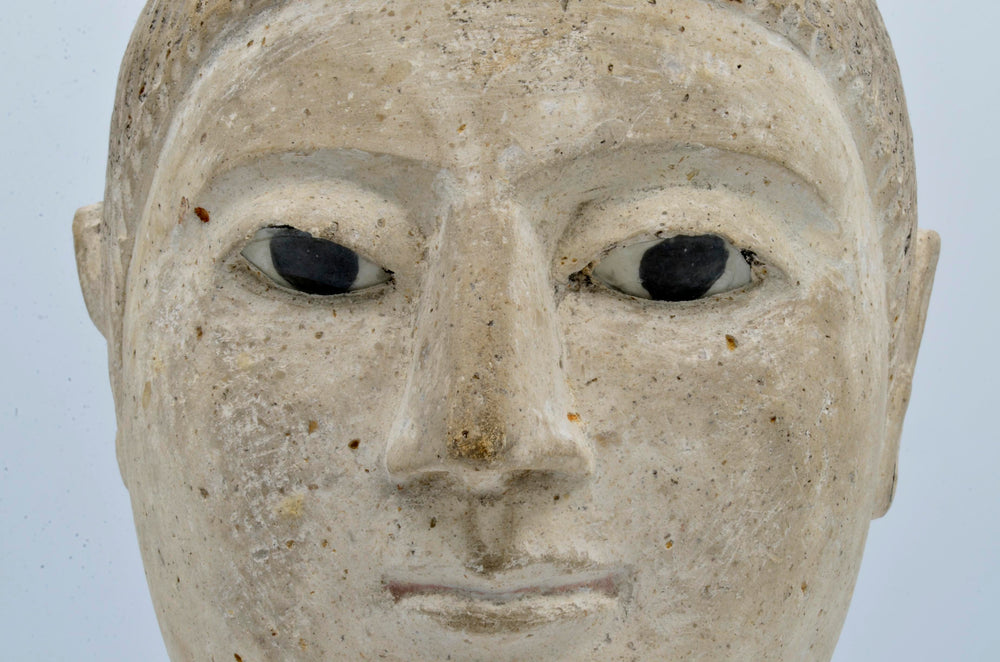
A beautifully naturalistic molded and modeled plaster (stucco) mummy mask depicting a young nobleman in an exceptional state of preservation. The idealized youthful face is rendered with a prominent straight nose, defined brow ridge, gently smiling fleshy lips, and large, wide-open eyes inlaid with contrasting black-and-white glass, which animate the face with a striking lifelike gaze. The closely cropped, stippled hair is arranged in the Roman fashion, and the figure wears a high cloak (mantle) rising at the neck, the bust terminating in the characteristic shoulder flange that once lay over the wrapped mummy.
The naturalism of the modeling—particularly the Romanized hairstyle and individualized features—is fully in keeping with second-century trends in Egyptian funerary portraiture, when plaster masks increasingly adopted Roman facial types and coiffures. Such masks, like the painted Fayum panel portraits, served to preserve the idealized likeness of the deceased for eternity in accordance with Egyptian funerary belief, expressed through the visual language of Roman Egypt.
Cf. S. Walker & M. Bierbrier, Ancient Faces: Mummy Portraits from Roman Egypt, British Museum Press, nos. 132 & 134, for closely related plaster masks of young men with inlaid glass eyes and stippled Roman hair. Cf. The Metropolitan Museum of Art, Mummy Mask of a Woman, Roman Period, A.D. 60–70, acc. no. 19.2.6, for the molded-plaster mask tradition. Cf. The British Museum, painted cartonnage and plaster Roman-period masks, ca. AD 100–120.
Dimensions: 7½ in. (19 cm) high, plus custom base.
Condition: Exceptional state of preservation; minor losses/edge chips to the shoulder flange consistent with age
Provenance: Collection of George Lois (1931–2022) and Rosemary Lois (1930–2022), New York. Acquired from Charles D. Kelekian (1900–1982), New York (the noted Kelekian family of Ancient Arts dealers, 667 Madison Avenue, New York). Accompanied by the original C. Dikran Kelekian gallery documentation describing it as an "Egypto-Roman plaster mummy mask of a young boy, probably from Fayum, Egypt, 1st–2nd century A.D." Old collection number "890" inscribed in black ink on the back of the neck, pronably from Kelekian.
This deep, named, mid-20th-century American provenance—traceable to the historically important Kelekian gallery and pre-dating the 1970 UNESCO Convention—is a major asset and strongly supports both attribution and lawful market presence.