7506
Roman Imperial, ca. 1st–2nd century AD
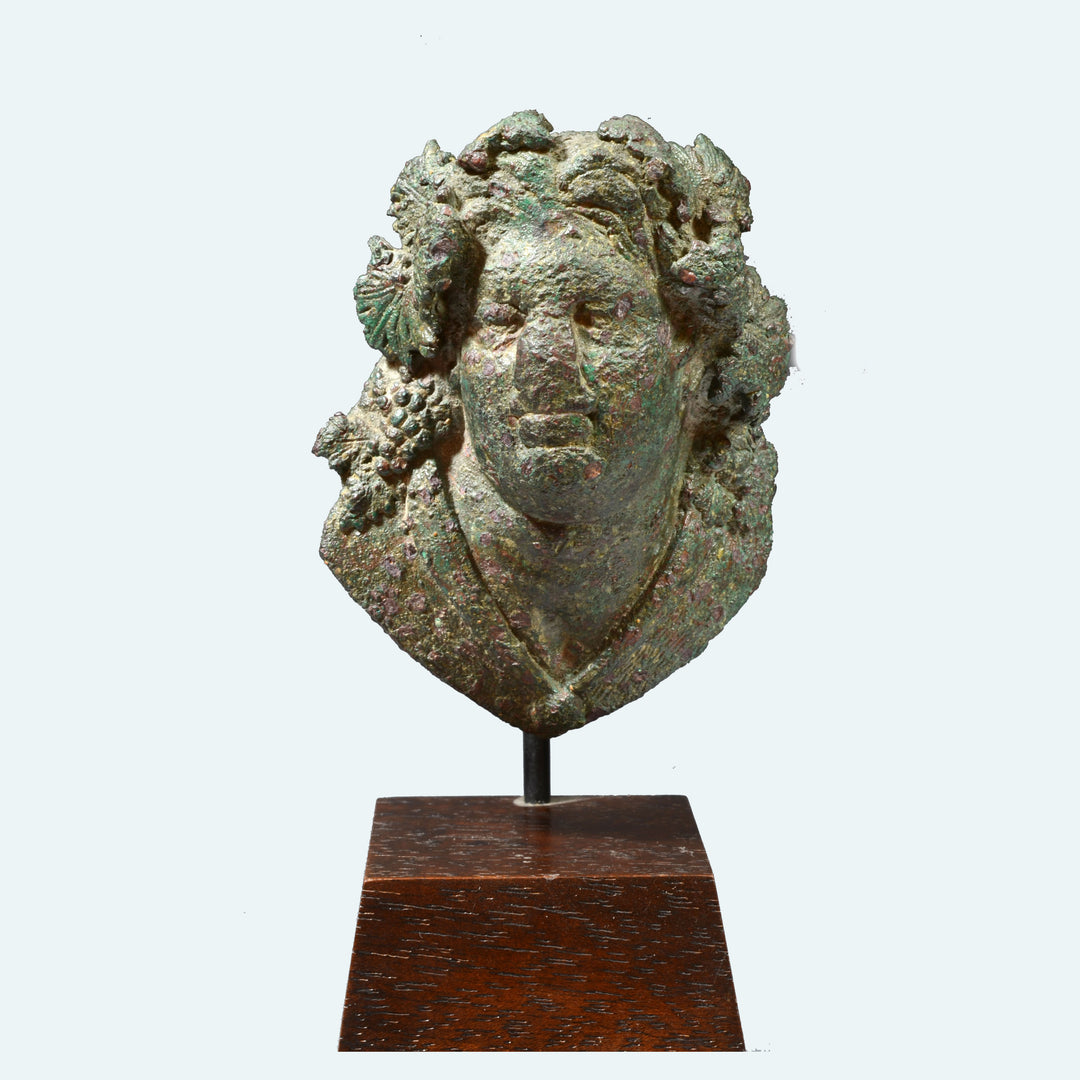
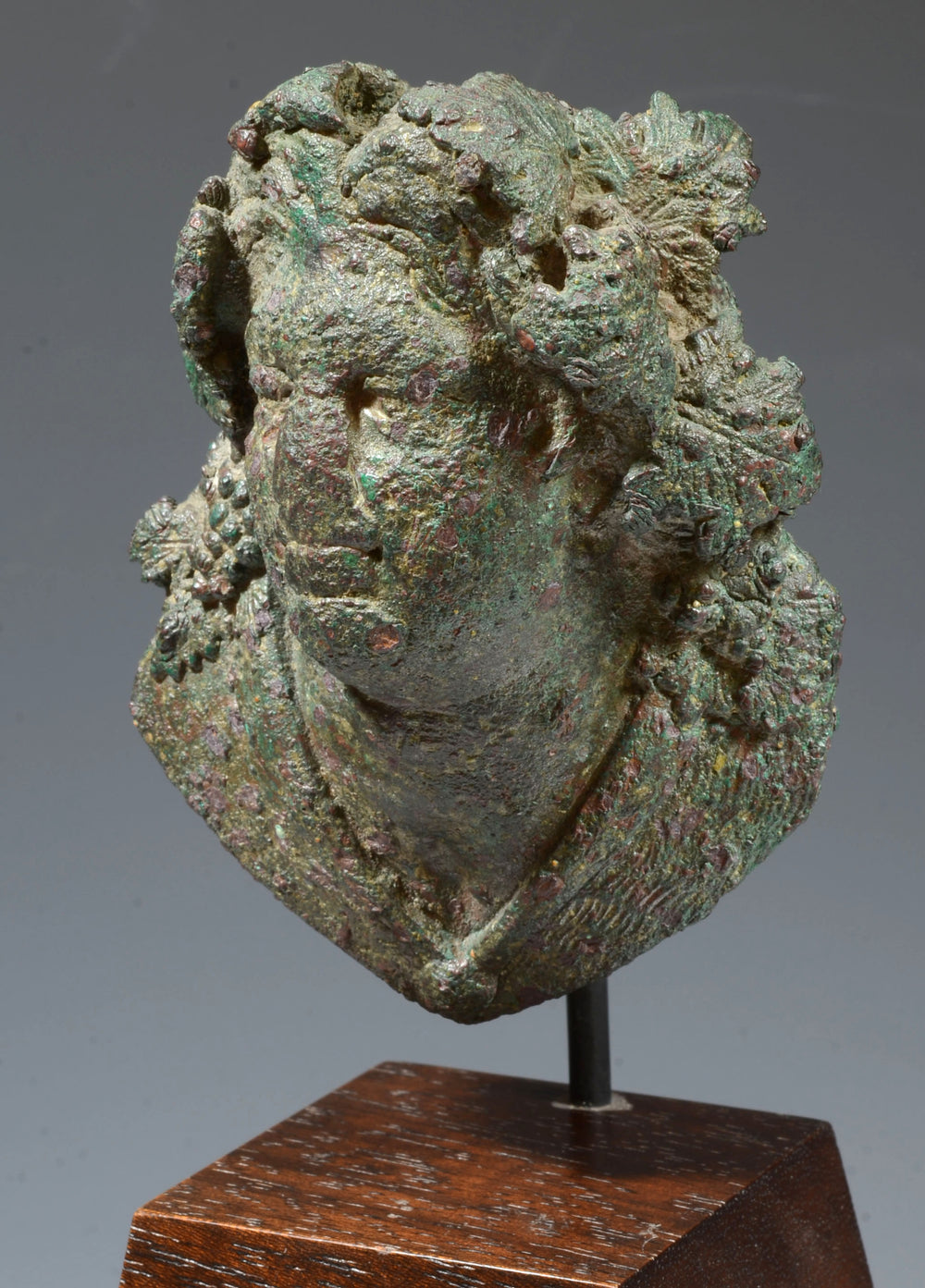
A finely cast solid-bronze appliqué depicting the youthful, idealized head and shoulders of Dionysus (Roman Bacchus), god of wine, fertility, and ecstatic revelry. The deity is crowned with a luxuriant garland of grape clusters and vine/ivy leaves forming a headdress, the signature attribute of Bacchic iconography. The reverse is hollow with the characteristic concavity and attachment remnants, indicating the piece was originally affixed as ornamentation to a larger object.
The serene, downcast features, soft modeling of the cheeks, and the heavy fruited wreath are typical of Roman Imperial Dionysiac appliqués of the period, several of which are dated "circa 1st–2nd century AD" in the market and museum literature. The deep cuprite-and-malachite patina (red and green) visible across the surface is consistent with extended burial.
Such hollow-backed bronze busts of Bacchus most often served as decorative appliqués mounted to furniture or vessels rather than as freestanding sculpture. Documented parallels were attached to the fulcrum (headrest) of a Roman dining couch (triclinium), or to the handle attachment / shoulder of a large bronze vessel such as a krater or situla.
The Bacchanalia and the Liberalia were related Roman religious festivals honoring Bacchus, the Greco-Roman god of wine, freedom, intoxication, and ecstasy, derived from the Greek Dionysia and Dionysian Mysteries. The Bacchanalia arrived in Rome around 200 BC and, after Senate restrictions in 186 BC, its rites were partly merged with the older Italic Liberalia of Liber Pater, celebrated each March 17. By the late Republic, Bacchus, Liber, and Dionysus had become essentially interchangeable, and their imagery flourished on luxury bronzes throughout the Imperial era.
Size: 4-1/4 in. (10.8cm) H (excluding mount); presented on a custom wood display mount.
Provenance: Prominent NY Private Collection.
Every object is guaranteed authentic and as described, and has been legally acquired and imported in accordance with U.S. and applicable foreign regulations on the movement and sale of antiquities. A signed certificate of authenticity with a description and photograph accompanies this object. Any restoration is described on the invoice.
Free insured shipping within the United States on most pieces; oversized works are quoted at checkout. We pack and ship ourselves, usually within two business days. International shipping by USPS or DHL is calculated at checkout; if your country is not listed, write to us. Customs forms state the full value; international buyers are responsible for duties and taxes.
Any object may be returned within 14 days of receipt for a refund or credit. Contact us first. See Buying from Us.