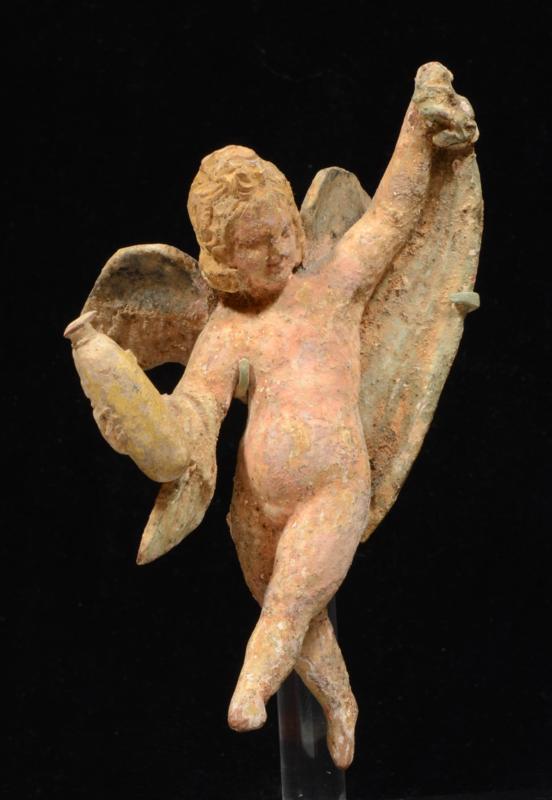
Egyptian Green Faience Triad Amulet of Isis, Horus the Child, and Nephthys

Egyptian Green Faience Triad Amulet of Isis, Horus, and Nephthys

17847

Shipping calculated at checkout.

  • Free insured US shipping on most pieces
  • Guaranteed authentic, with signed certificate of authenticity
  • 14-day returns

This piece has sold.

See available Egyptian pieces →

This site is protected by hCaptcha and the hCaptcha Privacy Policy and Terms of Service apply.

Late Period to Ptolemaic Period, ca. 664–30 B.C.

Molded in low relief on a small rectangular plaque with a high dorsal slab and integral plinth, the turquoise-green glaze softened by age to a warm, mottled sea-green tone flecked with rust-red inclusions where the faience body shows through. Horus stands frontally at the center as a nude striding child, larger than his companions in the customary hierarchical scale, his sidelock of youth just visible beside his rounded face; Isis stands at his right, identified by the stepped throne hieroglyph rising from her tripartite wig, and Nephthys at his left, wearing the basket-and-house cipher of her name, each goddess reaching in to clasp the young god's hand in the intimate protective gesture that expresses the amulet's funerary meaning; the same guardianship the sisters extended to Osiris and to the infant Horus, invoked here for the reborn deceased. The reverse preserves the diagnostic ribbed vertical suspension loop, pierced horizontally, exactly of the type popularized in Saite and later workshops. 
Size: 3.5 cm high (1 3/8 in.), the amulet is intact with light wear to the highest points of modeling, minor surface encrustation, and no restoration observed. A very closely related plaque of the same subject is preserved in the Metropolitan Museum of Art (26.7.890), with further parallels in the Cleveland Museum of Art (1940.624) and the Johns Hopkins Archaeological Museum.

Provenance: Private Collection, Southern England; Parthenon Gallery, London; Private Collection, Pennsylvania, acquired from the above, 14 July 2012

Every object is guaranteed authentic and as described, and has been legally acquired and imported in accordance with U.S. and applicable foreign regulations on the movement and sale of antiquities. A signed certificate of authenticity with a description and photograph accompanies this object. Any restoration is described on the invoice.

Free insured shipping within the United States on most pieces; oversized works are quoted at checkout. We pack and ship ourselves, usually within two business days. International shipping by USPS or DHL is calculated at checkout; if your country is not listed, write to us. Customs forms state the full value; international buyers are responsible for duties and taxes.

Any object may be returned within 14 days of receipt for a refund or credit. Contact us first. See Buying from Us.


You may also like


Recently viewed