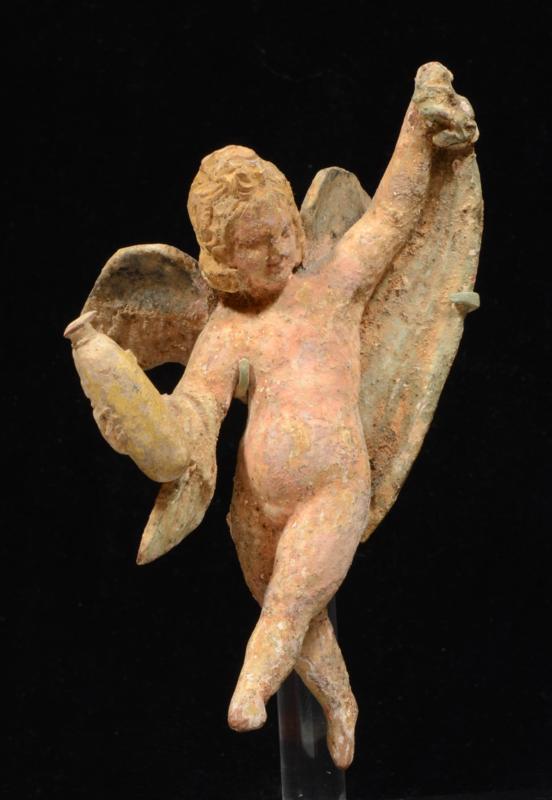
Fine Syrian Steatite Carved "Hand Bowl" (Libation Spoon)
Fine Syrian Steatite Carved Libation Spoon - Art for Eternity

Fine Syrian Steatite Carved "Hand Bowl" (Libation Spoon)

13909

Regular price$4,000
/
Shipping calculated at checkout.

  • Free insured US shipping on most pieces
  • Guaranteed authentic, with signed certificate of authenticity
  • 14-day returns

This site is protected by hCaptcha and the hCaptcha Privacy Policy and Terms of Service apply.

Syro-Hittite (North Syrian), Iron Age II, Circa 800 BC (8th Century BC)

A choice and rare ceremonial implement carved from dark brown steatite (soapstone), with a cylindrical shaft (tube) opening into a rounded, shallow spoon-form reservoir. The exterior bears a finely incised guilloche/petal band beneath the rim, while the underside is sculpted as a naturalistic open hand, fingers splayed to cup the bowl — the defining feature of the well-published Iron Age Syrian "hand bowl" type. The plain, tapering extension at the end of the tube is the original attachment element, designed to be set into a separately made vessel or handle. The vessel held precious oils or ointments employed in religious, royal, and official rituals of the Syro-Hittite world. The protective hand cradling the bowl carried apotropaic significance, symbolically "guarding" the sacred liquid and the rite performed with it. The delicate modeling of the fingers and nails, together with the petal-frieze band, situates the piece firmly in the stylistic tradition of north-western Syria in the second half of the 8th century BC. The rich, deep-brown polished surface and minor edge wear are entirely consistent with its great age and ceremonial handling.

Size: 4-1/2 in. L × 1-3/8 in. H (11.4 cm × 3.5 cm), excluding mount; on custom wood display mount. 

Compare a similar example in the Joseph Turnbach Collection. The type — classified by Scigliuzzo (2004) and Mazzoni as a "spoon-stopper" or "hand/lion bowl," with a typology based on the underside motif (plain, hand, palmette, cross, lions, sphinxes) — is paralleled by stone and ivory examples in the Louvre and British Museum, and by excavated finds from Nimrud (North-West Palace and Burnt Palace), Tell Halaf, Hasanlu, Hazor, Kinneret, and Yunus. The naturalistic hand carving on the present piece corresponds specifically to dated 8th-century BC comparanda.

Provenance: Ex prominent NY collector Daryl G. Kulok Collection; acquired in Israel in the 2000s. Rare!

Every object is guaranteed authentic and as described, and has been legally acquired and imported in accordance with U.S. and applicable foreign regulations on the movement and sale of antiquities. A signed certificate of authenticity with a description and photograph accompanies this object. Any restoration is described on the invoice.

Free insured shipping within the United States on most pieces; oversized works are quoted at checkout. We pack and ship ourselves, usually within two business days. International shipping by USPS or DHL is calculated at checkout; if your country is not listed, write to us. Customs forms state the full value; international buyers are responsible for duties and taxes.

Any object may be returned within 14 days of receipt for a refund or credit. Contact us first. See Buying from Us.


You may also like


Recently viewed