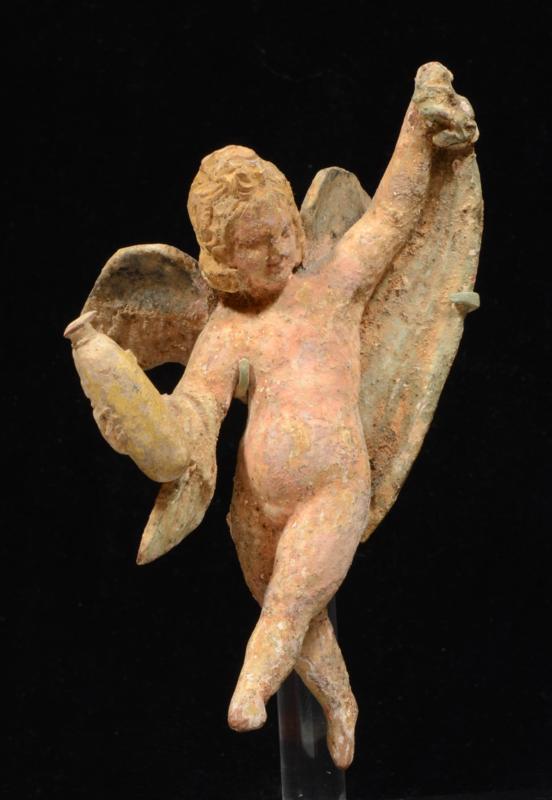
Greek Boeotian Terracotta Papades Plank Idol

Greek Boeotian Terracotta Papades Plank Idol

17511

Regular price$2,450.00
/
Shipping calculated at checkout.

  • Free insured US shipping on most pieces
  • Guaranteed authentic, with signed certificate of authenticity
  • 14-day returns

This site is protected by hCaptcha and the hCaptcha Privacy Policy and Terms of Service apply.

Aegean, central Greece, Archaic period, mid-to-late 6th century BC, ca. 550–500 BC.

Hand-modeled buff terracotta, nearly two-dimensional, with a tapering plank body rising from an oval/ledge foot ring, short peg arms projecting and slightly forward-tapering at the shoulders, and a deeper, rounded head rising on a cylindrical neck and a geometric garment panel of vertical and hatched strokes in iron-oxide brown/red slip.  The head wears an arched polos crown with a prominent inwardly rolled volute/quiff on the forehead — the defining feature that identifies the figure as a goddess (commonly interpreted as Demeter, Hera, or Persephone), and the reason these idols are also called "Papades" after their priestly/crowned appearance.

These flat, plank-bodied goddess figures are one of the most distinctive votive/funerary types of Archaic Boeotia, produced at centers such as Tanagra, Thebes, Ritsona, and Akraiphia, and recovered primarily from cemeteries and sanctuaries. They sit at the pivotal Archaic moment when Greek artisans are moving from the flat, frontal, stiff conventions inherited from Egyptian, Phoenician, and Syrian prototypes toward the fully three-dimensional treatment of the human body seen in contemporary kouros and kore statuary, a trajectory that culminates in the Classical and then Hellenistic achievements of the following centuries.

Size: 5-1/2 inches (14cm) high.   
Provenance: New Jersey Collector.
Compare similar example in The British Museum and read about the types in Higgins, Reynold, 'Tanagra and the Figurines' Princeton University Press 1987.

Every object is guaranteed authentic and as described, and has been legally acquired and imported in accordance with U.S. and applicable foreign regulations on the movement and sale of antiquities. A signed certificate of authenticity with a description and photograph accompanies this object. Any restoration is described on the invoice.

Free insured shipping within the United States on most pieces; oversized works are quoted at checkout. We pack and ship ourselves, usually within two business days. International shipping by USPS or DHL is calculated at checkout; if your country is not listed, write to us. Customs forms state the full value; international buyers are responsible for duties and taxes.

Any object may be returned within 14 days of receipt for a refund or credit. Contact us first. See Buying from Us.


You may also like


Recently viewed