




When Myth Comes to Theaters: Real Antiquity for the Age of "The Odyssey"
Christopher Nolan's "The Odyssey" — shot entirely on IMAX film, starring Matt Damon as the wandering king of Ithaca — has been filling theaters since its July 17 release, and audiences are leaving newly hungry for the world of Homer: the wine-dark sea, the wrath of the gods, the decade-long war beneath the walls of Troy (Wikipedia). At Art for Eternity, we've spent decades living in that world in a more literal sense. Long before Nolan's cameras rolled, the actual men and women of the Bronze Age and Archaic Greek world were shaping the clay, casting the bronze, and burying the grave goods that survive today as tangible fragments of the Homeric age. Here are a few pieces from our current collection that speak directly to the film's themes — not props, but the real thing.
A Jar from Odysseus's Own Time

The most direct connection in our gallery to the world of the film is also the humblest object: a Mycenaean Terracotta Stirrup Jar, Late Helladic III, circa 1300–1200 BC. This is not a later evocation of the Bronze Age — it is the Bronze Age, made and used in the same generations that later poets would remember as the age of the Trojan War. Squat and lentoid in form, with a false central neck, an offset spout, and a broad double-arched handle, the jar is painted in dark reddish-brown over fine buff clay, its shoulder banded with spirals and hooked motifs and its handle-bridge marked with a bold concentric circle. These vessels carried perfumed oil across the Mycenaean world and turn up as grave goods and household containers alike, with closely comparable examples held by the Walters Art Museum and the Metropolitan Museum of Art. Ours retains an attractive burial patina, scattered encrustation and root marks, and the small chips and abrasion one expects of true age, with an old collection label still on the underside. It measures 3 inches (7.6 cm) high by 4½ inches (11.4 cm) wide and carries a documented provenance to a Utah collection acquired in the 1970s.
Priced at $1,850 — view the piece
The Chariot Warfare Behind the Iliad's Shadow

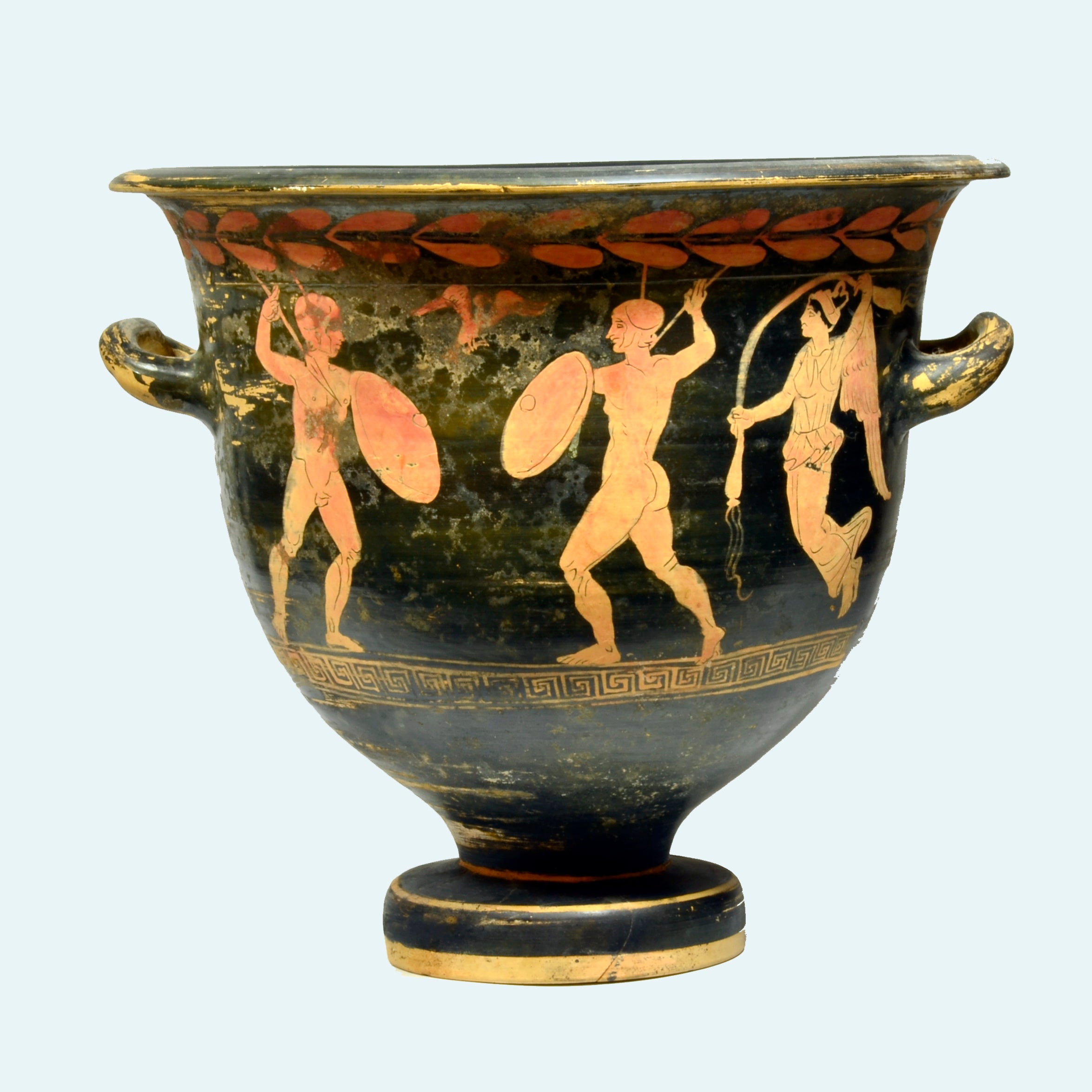
Odysseus's saga begins only after ten years of war at Troy, fought in the very manner shown on our Attic Black-Figure Pottery Lekythos with Quadriga Chariot, circa late 6th to early 5th century BC. Though painted a few centuries after the Trojan War's traditional date, this slender oil vessel captures exactly the martial world Homer's audiences pictured: a four-horse chariot at full gallop, driven by a charioteer with an attendant figure beside him, rendered in black-figure technique with added red and white for an unusually rich, almost tricolor effect. Standing 7¾ inches (19.5 cm) tall, the lekythos has a period repair at the neck and handle along with expected surface wear and minor losses, and it compares well with chariot and race-scene lekythoi held by Princeton, LACMA, the R.D. Milns Antiquities Museum, and the Getty. Provenance traces to a Utah collection acquired in the 1970s.
Offered at $3,250 — view the piece
Mars, and the Warrior Ideal Odysseus Embodies

Nolan's Odysseus is, above all, a soldier trying to get home from a war — and few objects capture the ancient warrior ideal as directly as our Roman Bronze Figure of Mars, circa 1st–3rd century AD. Cast solid in bronze, the youthful god strides forward nude but for a military cloak (paludamentum) gathered over one shoulder, his head turned sharply beneath a crested helmet, arms once extended to hold a now-lost spear and shield. The lively contrapposto and incised musculature are typical of provincial Roman votive bronzes, of a type produced across the empire for household shrines, with a celebrated silver-inlaid parallel held by the British Museum. Standing 2⅝ inches (6.7 cm), or 3 inches (7.6 cm) on its fitted display stand, the figure shows only minor wear and a missing foot, entirely consistent with its age, and comes from a Connecticut collection assembled in the 1980s and '90s.
Priced at $2,000 — view the piece
A Goddess for Penelope's Patience, or Persephone's Return

No figure haunts the Odyssey more quietly than the women who wait, transform, and endure — Penelope at her loom, Persephone moving between the world of the living and the dead. Our Greek Terracotta Votive Head of a Goddess, Hellenistic period, circa 300–250 BC, may depict Persephone herself: the face heavy-lidded and serene beneath a cylindrical polos, the thick center-parted hair still bearing traces of white pigment. The type finds a published parallel in Carratelli's "The Western Greeks." Measuring 4¾ inches (12.1 cm) high on its own, or 7½ inches (19.1 cm) mounted on the included travertine stone base, the head carries a German collection provenance dating to between 1987 and 2000.
Available for $1,000 — view the piece
The Real Odyssey Is Still Being Written
Nolan's film will send a new generation back to Homer's text — but the objects above were never fiction to begin with. Each one survived three thousand years of burial, rediscovery, and careful stewardship to reach our gallery on Manhattan's Upper East Side, and each is available now to become part of a private collection. Visit us at howardnowes.com or stop by 303 East 81st Street to see them in person.